
Skip to content
Blog Tag banner image
Connestoga wagons driven by robots heading towards the OpenTAP building.
Using AI to Migrate Legacy Test Automation to OpenTAP

AI doesn't remove engineers from the migration; it removes the drudgery. Agents do the porting, but engineers own every change, and side-by-side results prove the new system before you switch over. By using AI with a human in the loop, migration to OpenTAP stops being a leap of faith and becomes a controlled, measurable project.

Read more
Deploying OpenTAP in a Docker Container

Containerizing OpenTAP takes just a few steps: install OpenTAP and plugins on a .NET runtime base, add test plans, and run headless. The result is a versioned, portable image that turns a hand-built test station into something you can rebuild, share and trust. With containerization, every station runs the same environment, new stations spin up with a docker pull, conflicting plugin sets stay isolated, and rolling back is as easy as changing a tag.

Read more
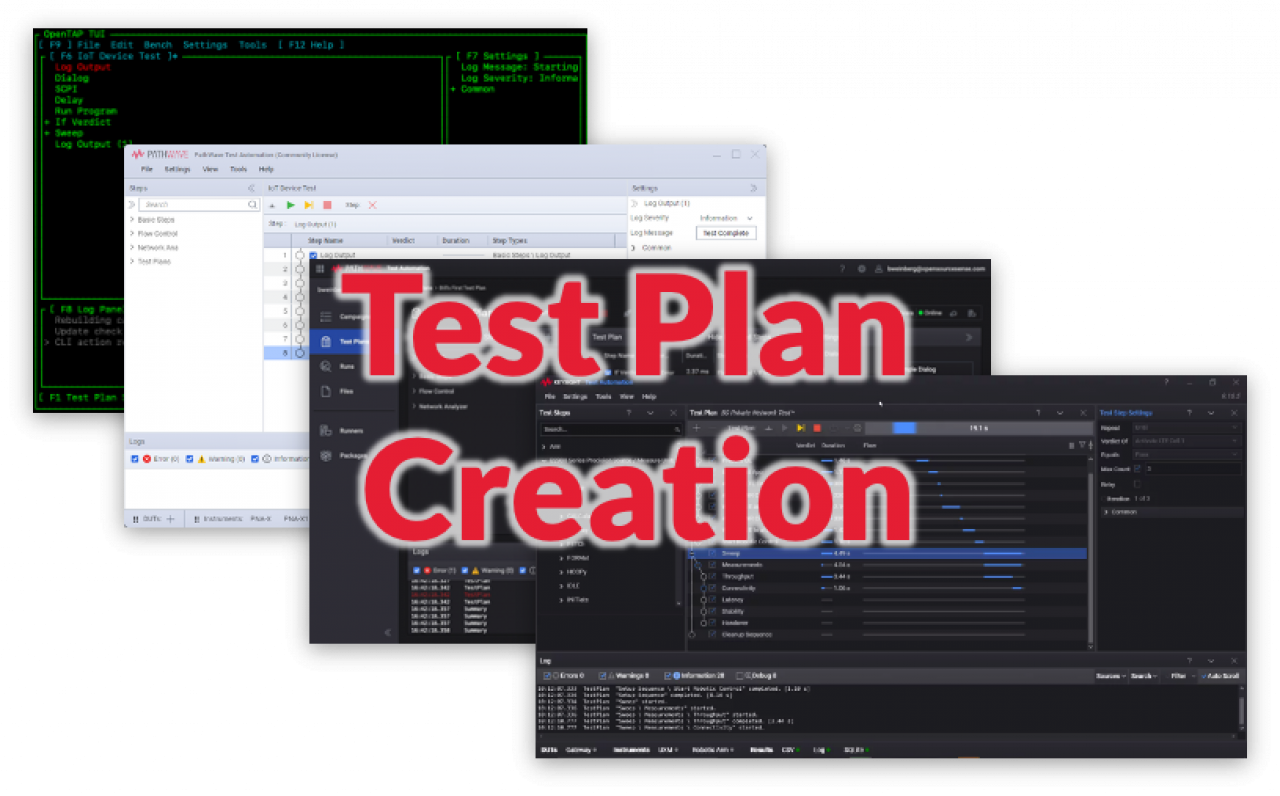
Blog Banner - Test Plan Creation.
OpenTAP Test Plan Creation

The OpenTAP platform, and Keysight PathWave Test Automation products built with it, consume and interpret Test Plans. Test Plans don't spontaneously spring into existence, and they almost always evolve over time, requiring tools to compose and maintain them.

This blog reviews options for building and modifying OpenTAP test plans, including open source, and community-licensed and commercially-licensed tools from Keysight.

Read more
Logos of platforms to host OpenTAP beyond Windows.
OpenTAP on ARM-based Systems

This blog demonstrates how hosting the OpenTAP test automation engine itself on ARM-based systems is a relatively straightforward task. Since OpenTAP is built with .NET, it enjoys the hardware abstraction provided by the Microsoft application framework, with very few hardware-specific dependencies or idiosyncrasies. As examples, the blog shows how to target an Apple M1 host running Ubuntu Linux, an ARM64-based Raspberry Pi system, and an M1 Pro-based MacBook Pro running MacOS.

Read more
Animated OpenTAP architecture diagram
Contributing plugins to the OpenTAP Project

OpenTAP makes customization easy by offering a plugin-based architecture. The OpenTAP project includes a range of ready-to-use plugins to support instruments, DUTs, user interfaces, results listeners and more. Plugins also originate from OpenTAP ecosystem participants - hardware manufacturers, software suppliers and end-users. If you have developed an OpenTAP plugin and are eager to share it with other ecosystem participants, read this blog to understand how to host your plugin in the OpenTAP project repository.

Read more