
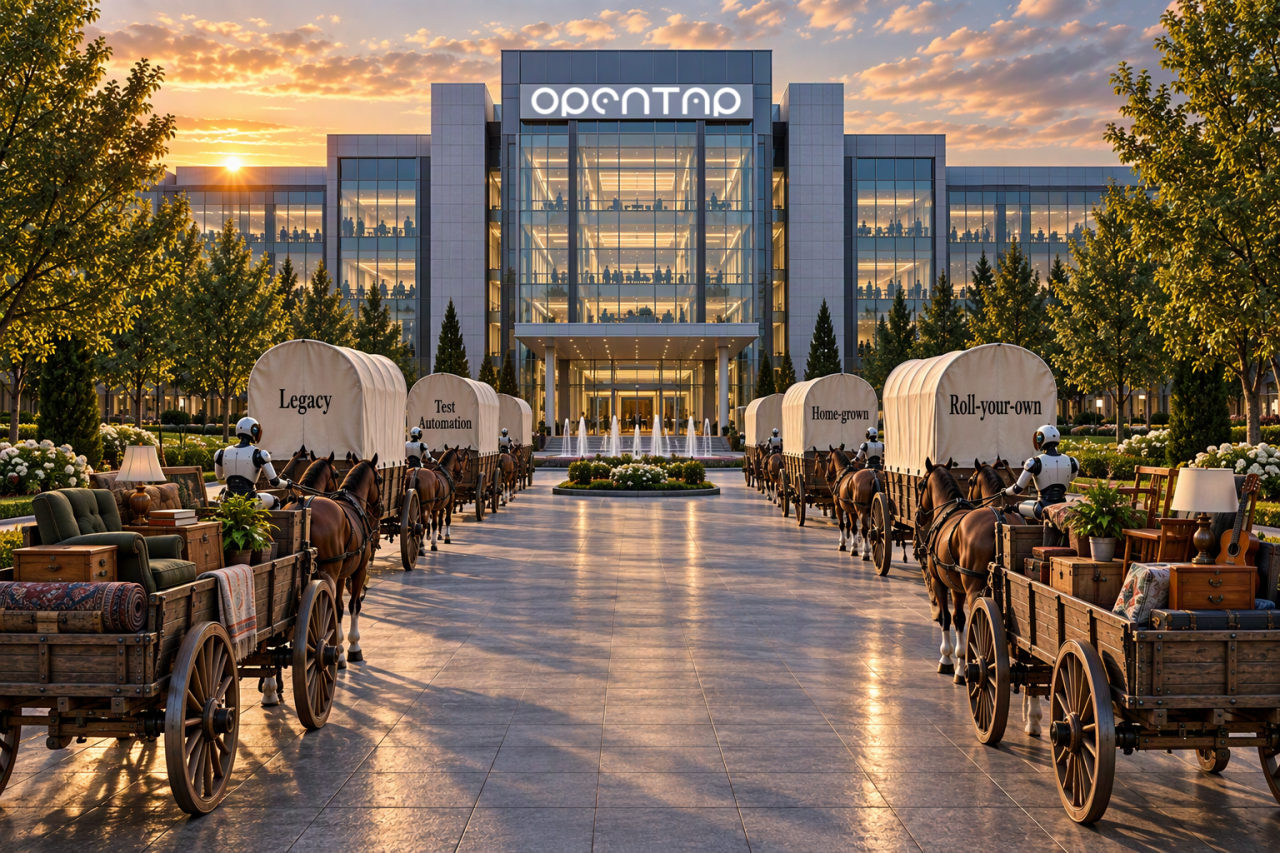
Most test organizations know the feeling – years of investment locked into in-house frameworks, aging scripts and tribal knowledge that only a few engineers fully understand. Being stuck in a legacy trap: migration to a new test automation platform is risky and expensive, but so is running in place.
Moving to an open, modern platform like OpenTAP makes strategic sense: a shared sequencer, a plugin model, package management and a global ecosystem of users, developers and strategic commercial partners. The porting effort has traditionally been the blocker. Rewriting hundreds of tests by hand ties up your best engineers for months, and every hand-ported test carries the risk of a subtle behavior change.
AI coding agents change that math. Used well, coding agents can turn a multi-quarter rewrite into a guided, verifiable migration in four steps:
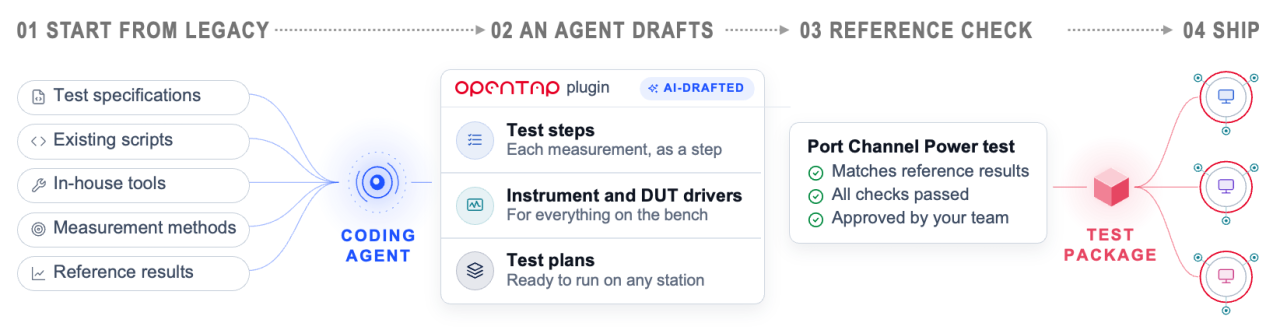
Step 1. Start from Working Legacy
You don't need to write new requirements before you begin (although you can). The raw material for the migration already exists within your organization:
Test specifications that define what each test and what it must prove.
Existing scripts that show how tests run today.
In-house tools that handle setup, data logging and reporting.
Measurement methodologies that explain why and how tests are built today.
Reference results that capture what "correct" looks like.
Together, these legacy artifacts record both what you test and how you test it. The more context you supply to the coding agent, the more faithful its output will be.
Step 2. The Coding Agent Drafts an OpenTAP Solution
A coding agent reads those inputs and drafts an OpenTAP plugin, mapping legacy concepts onto OpenTAP building blocks:
Test steps. Each measurement becomes its own reusable step, with settings exposed as parameters rather than hard-coded values.
Instrument and DUT drivers. Every piece of equipment on the bench (locally and remotely), and the device under test itself, receives a driver that separates hardware control from test logic.
Test plans. Steps are assembled into sequences that are ready to run on any station.
The agent handles the repetitive translation: reading old code, writing new classes, wiring parameters and producing a first pass at documentation. Your engineers stay in the driver's seat. They set priorities, answer the agent's questions about ambiguous logic and review each change the way they would review a colleague's pull request. Every facet of the migration is approved by your team before the process moves forward.
Step 3. Check Against Reference
AI-drafted code is only as good as its proof. Old and new implementations run side by side on the same hardware and the same devices, comparing results.
Take a port channel power test. It is accepted only when three conditions hold: it matches reference results, all checks pass, and your team approves it. Nothing cuts over until the numbers agree. When they don't, the discrepancy is itself valuable. It either reveals a porting error for the agent to fix or exposes a long-hidden quirk in the legacy system.
Step 4. Ship
Validated steps, drivers and plans are bundled into a versioned OpenTAP package and deployed consistently to every station. Required versioning means that each station runs a known, reproducible configuration. Future fixes and new tests roll out the same way, so the discipline you built during migration carries forward into everyday operation.
Lessons for AI-assisted migration
Start with a pilot. Pick one representative test with clean reference data. It calibrates how much review the agent's output needs and builds team confidence before you scale.
Treat reference data as a contract. Capture golden results, including tolerances, edge cases and failing-DUT behavior, before porting. Without them, "matches" is a matter of opinion.
Expect hidden behavior. Legacy code often encodes undocumented fixes: settling delays, retry loops, instrument firmware workarounds. The coding agent can flag these explicitly rather than silently dropping or copying them.
Don't just transliterate. A line-by-line port preserves old bad habits. Use the migration to restructure around reusable steps and shared drivers, so the new code is easier to understand and to maintain than the legacy code base.
Involve humans in the measurement science. Agents are strong at code. Calibration, measurement uncertainty and test-limit decisions still belong to engineers.
Mind your IP and environment. Specs and scripts often contain sensitive information. Confirm where the agent runs, how your data is handled, and segregate it from live production stations.
Let the agent document as it goes. Ask the agent to produce a mapping from each legacy function to its OpenTAP equivalent. The resulting trail speeds review, supports audits and helps future maintainers.
Measure the migration. Track tests ported, first-pass match rate and review time per test. These metrics show where the agent needs better context and help youyou’re your team forecast the rest of the effort.
The Bottom Line
AI doesn't remove engineers from the migration; it removes the drudgery. Agents do the porting, but engineers own every change, and side-by-side results prove the new system before you switch over. By using AI with a human in the loop, migration to OpenTAP stops being a leap of faith and becomes a controlled, measurable project.